Saturday, June 4, 2011

Ain't No Mottainai Enough: Gardena Ramen Spot is Smokin' Good

Along with the the superbly criminal pun that this restaurant inspires, Mottainai is yet another foodie find, courtesy of my friend Ally. When she told me to meet her at the ramen place in Pacific Square, I was afraid that the landmark Fukagawa had closed and been replaced by a new upstart ramen shop. Happily, I was wrong.

Great noodle places are like speakeasies, with hidden entrances like the one at Otafuku on Western Avenue. After a few sweeps of the shopping center and another phone call, I realized that the place with the blue curtain with the endless knot on it was Mottainai. That's what happens when you don't know how to read Japanese.


Behind the curtain: Mottainai awaits with bowls of flavorful ramen.

The mysterious blue curtain is deceptive. Stainless steel walls give the restaurant a modern cleanliness while pine tables make it cozy. The motto painted on a cornice declares Mottainai's environmentally conscious philosophy: "Recycle + Reuse + Reduce + Respect." Loosely translated, the word "mottainai" is a lamentation of waste. It makes for an ironic counterpoint to the very act of making soup, which usually involves distilling the essence of food from scraps and parts that are normally thrown away.


In the spirit of "mottainai," they recycled the cover art from a No Doubt album for this decor.

While "Sapporo Miso Lover" might sound like the title of either a Gwen Stefani song or her latest clothing line, it is the trademark item on Mottainai's menu. The soup is a specialty of the Sapporo, which is the capital of Hokkaido, Japan. Its preparation involves flaming a mixture of miso and lard in a blazing wok. I watched entranced as one of the chefs, Hiro Igarashi, did just that behind a glass panel at the counter.


It all happened so fast. Artsy shot that exposed after the flames died down. With extra bean sprouts.

I added extra toppings of fresh spinach and an egg. I also had to have the "red bomb," a ping-pong ball of chili paste that added a nice, but not obliterating heat to the soup. Mottainai also offers another "bomb" of garlic and pork fat if you want your broth really porky. But my Sapporo already had plenty of porcine goodness, coupled with an unusual smoky flavor from the toasted miso.


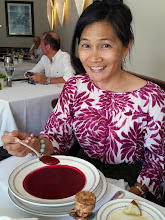
Bombs away: A paste of red chilies complements the toasted miso and pork-rich broth of the Sapporo Miso Lover.


Chef Hiro offered me tastes of all the different broths they serve at Mottainai, if I had room for it after my huge bowl of soup. Sadly, I had to decline until next time. My tastebuds were too busy celebrating - and the rest of me was too full - to appreciate the savory subtleties of a "flight" of different soups.

Each of the ramen offerings were named after their region of origin: Tokyo, Yokohama, and Gardena. Yes, Gardena. For those of us who grew up in the South Bay, the city was our first introduction to Japanese food and culture. For those of us who grew up in the South Bay in the 1970s, Gardena was our first introduction to any Asian food and culture. So it deserves having a ramen named after it.

Ironically, Nissin Foods, makers of the ubiquituous Top Ramen, Cup of Noodles, and other products that have introduced mainstream palates to the joys of ramen is also located in Gardena.

I'm not knocking the stuff - Top Ramen has gotten more Americans through college than the Pell Grant. But you really haven't had ramen until you've sat down in front of a steaming bowl in one of any number of amazing hole-in-the-wall noodle shops between Crenshaw and Vermont. And you haven't really explored the surprising potential in a ball of pork fat until you've been to Mottainai.

Thursday, June 2, 2011

Flipping For Olive Oil Pancakes

Whenever I see an olive tree, I am instantly transported to the house my sisters and I grew up in on Pullman Lane. My father had planted an incredible rock garden in the front and back of the house. As a kid, I felt kind of cheated that we didn't have a nice green lawn, just carefully laid-out islands of gravel and smooth round pebbles.

Artfully placed within these little islands were a veritable Eden of trees and plants, both ornamental and fruit-bearing. Along with the requisite assignation of a lemon and avocado tree in our Southern California backyard, there was a fig tree, stalks of sugar cane, and a loofah gourd vine, the fruits of which we dried in the sun and used as bath sponges. We girls grew whatever we could from those packets of seeds that were sold in the supermarket: cherry tomatoes, strawflowers, sunflowers, sweet peas, and cornflowers. As an experiment one day, we buried stubs of raw potato and were absolutely thrilled when several weeks later, we dug up a tiny, dun-colored spud the size of the head of a pin. It was hardly edible. Frankly, it was hardly visible. But we were excited that we grew it ourselves.

The gold standard of our agrarian experience was the exotic foliage that Dad had planted. The centerpiece of our front yard was a beautiful olive tree, the first one I had ever seen. I used to climb it, or rather, wedge myself into the inverted tripod of its trunk, feeling shelter in its lithe and leafy branches. Once, I even attempted to eat its bitter, unprocessed fruit, which I instantly spit on the ground in dismay.


You haven't really been a kid if you've never worn "olive fingers."

The appearance of trays of canned black olives, mixed nuts, and celery sticks on our mother's coffee table meant that company was coming. We would steal them and put the pitted ones on our fingertips like chubby jet- colored finger puppets. Much later, I would discover the briny delight of the Kalamata olive and the piquant ecstasy of green pimento-stuffed olives in a martini. Unless I have at least four plump olives perched precariously on the wide rim of my glass, it's not a real martini. Surely, this would count toward my five-a-day fruit and veggies. (By the way, it's eight-a-day in Europe.)

I remember an ancient bottle of Pompeii Olive Oil on our kitchen range at home. I never saw my parents use it in anything, but I remember its musty, yet peppery smell. The first time I was served Italian bread sans butter, I must have looked at the tiny saucer of chartreuse liquid dotted with balsamic vinegar in puzzlement. But as in the case of sushi, croissants, and soccer, Americans are quick to adapt to new ideas from other lands. Well, at least when it comes to food.

Last summer, I discovered tortas de aceite, the crisp and lightly sweet Spanish cracker that gets its distinctive nutty flavor from olive oil. When I first saw them at Surfas, I imagined the plain unassuming pastries as being baked in a convent and wrapped in their quaint oily paper by nuns. They are not, but the fiction made them taste even better.


These would be more popular than Girl Scout cookies if we could get "The Flying Nun" as a spokesmodel.

Maybe I channeled nuns when I found tortas de aceite because of the memory of a similar pastry from when I was in the second grade at Our Lady of Guadalupe Elementary School. One of my best friends, who bore the imposing name of Esperanza Solbach, shared a piece of the homemade "doughnut" that her mother had put into her lunchbox. Even at that age, I could tell it was homemade, its yeasty goodness accentuated with the merest sprinkling of cinnamon, sugar, and nutmeg.

Sadly, at age seven, I had not thought to ask my friend for the recipe and have been trying to find that elusive taste ever since, the tidbit of cake looming large in my imagination like Proust's madeleine. Ironically, mass-produced versions of said madeleine are available at Starbucks and Trader Joe's. But whatever it was that my schoolyard chum had in her lunch is, like that day, long gone. I've even done extensive hands-on research on the native desserts of both Spain and Germany, figuring the recipe must have come from one side of her parents' culinary heritage. I came up empty, but found that Alpine Village actually does serve a mighty fine German chocolate cake - despite the face that the recipe isn't German at all, but refers to the brand of baking chocolate that is used.

Fast forward to the present, which has me watching a clip from "Made in Spain," a PBS series by chef Jose Andres with great interest. A native of Asturria with the accent to match, the show's ebullient host makes even raw egg sound entertaining: "The omelet is crying of happiness." In Andres's world, ingredients have lives and voices of their own, with flavors that "talk to each other" and pancakes that demand, "Jose, it's time to flip me over."


Chef with extreme case of olive hand, film at 11.

Hoping that these pancakes would recapture that childhood memory, I made them for my nephews. Although they are years away from appreciating the health benefits of extra virgin olive oil and 60 percent cacao in the chocolate chips, I think the main attraction for the boys was simply the fact that any chocolate with breakfast is a good thing.

So, did the olive oil pancakes taste like Esperanza's mom's doughnut? Despite their crispy exterior and dense, chewy texture, they didn't. But hopefully they'll make a new memory for two boys who will know when they're old enough to cook where they can get the recipe.


Tuesday, May 10, 2011

What's At Steak: Remembering Dad

My Dad was the chef of our family. Having emigrated from the Philippine province of Ilocos, he arrived first in Hawaii with his paternal grandfather before they moved to the mainland and settled in Los Angeles. I was told that at one point, he worked as a cook at a place on Manchester called the Chalon Restaurant, where I assume he gained his understanding of swanky mid-century American gastronomy.

Dad was the celebrity chef of the family on weekends, and would occasionally recreate dishes like lobster Thermidor for my sisters and me when we were growing up. Most of the time, Mom would take care of after-school snacks, birthday cakes, and general kitchen training for my sister and myself. But Dad was the one who gave us an opportunity to eat like the Rat Pack. Although age and convenience have changed our eating habits over the years, I have retained a love of crisp, chewy slices of bacon, plates of spaghetti with thick meat sauce, and medium rare steaks.


Five guys I would have loved to have dinner with. At least three of them would have to sing for their supper.

Unlike today’s houses, where children and their accoutrements dominate a family’s décor, my two sisters and I grew up in the world of grown-ups, to be seen and sometimes heard on demand. Our immigrant parents subscribed to the American dream with a vengeance and my first glimpses of adult life included a sunken living room, a huge console with a built-in television and stereo, and cigars proudly given to Dad's friends to celebrate a daughter’s birth. (The custom ended with Joselyn, who ironically, is the only one of us who smokes.

I've raved about the strip steak at Grand Casino, but now I realize why I like it so much. The simplicity of its seasoning and the crisp and chewy exterior of the steak remind me of home cooking when Dad presided over the kitchen range. Joselyn remembers that Dad would not only trim the fat off the steaks before cooking them, but fry them in oil and give them to us as a snack. We enjoyed them back then, but I've wondered if this is why she became a vegetarian.

At Grand Casino, when my steak arrives at the table, it always looks like too much food. But I always end up eating the entire thing because it's so good. Tonight I ate it all, not only because of that, but because of an elusive flavor that I cannot name, tinged with nostalgia, curiosity, and longing.


A cut above: the strip steak at Grand Casino is a memory on a plate.

Dad was an old-school parent, fairly stern and of few words. But every summer, I was allowed to accompany him on his rounds as a gardener, back in the days when they did more than cut the grass and take a leaf blower to the yard.

Why I was chosen to do this, I don't know, but I lolled about in his renovated yellow bus with him and his two helpers. I read a lot, daydreamed, and learned the names of almost every plant, tree, weed, and flower that was cultivated in Southern California. We didn't talk much but I remember being really impressed that he could speak fluent Spanish to his assistants, that he would transform an unruly boxwood into a thing of beauty, and that he got to drive around in a renovated yellow bus all day.

Losing a parent is difficult at any age, and probably more so when they live a long life. It is easy to lionize a parent that is gone, and I wonder how Dad would have weathered all the changes of the last 30 years, within the family and throughout the world. I wonder now if we ever would have gotten to talking, really talking. I wonder if he would be happy about how my sisters and I turned out, how he would spend time with the grandsons he never met, if he would ever get the hang of an iPhone or a microwave.

May 10 was Dad's birthday. According to an L.A. County death certificate I found online, he would be 102 this year. Later, I found evidence that he was much younger than that, but I like to think of him as a centenarian; I could get his image put on a quarter that way. In that time, my sisters and I have only managed to celebrate his birthday with a special meal a couple of times. But I think that each of us celebrates him in her own way every time she eats well.